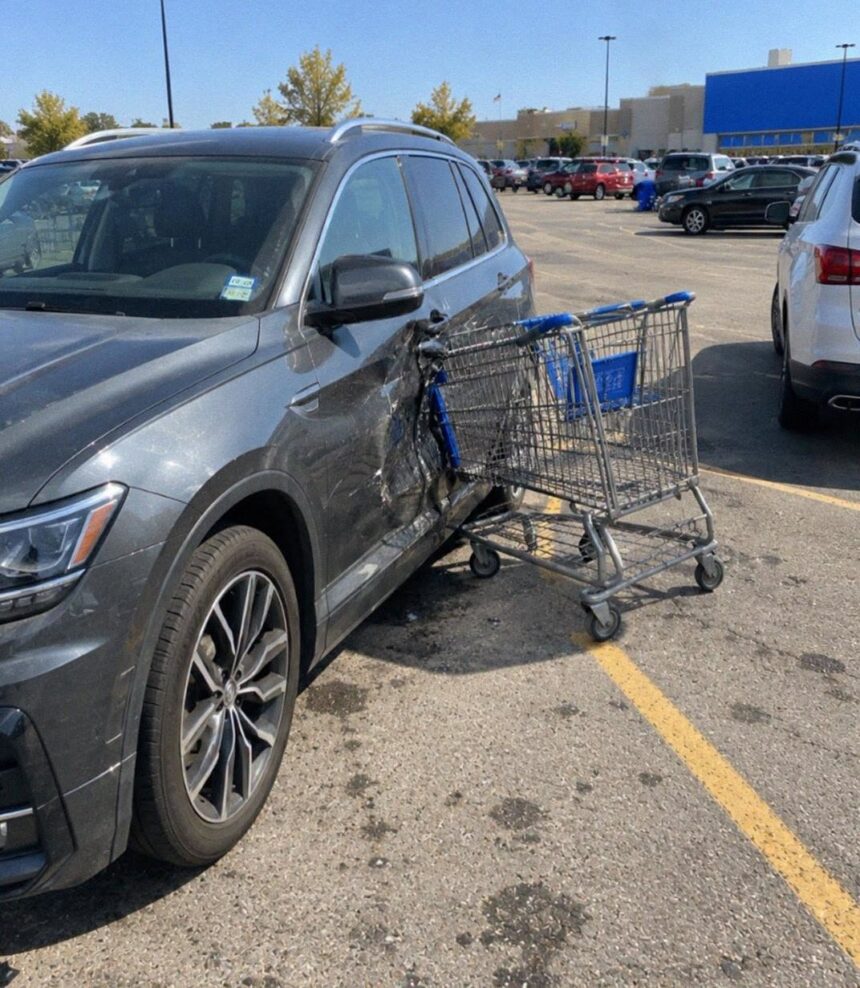
I refused to fight with a woman over a shopping cart and went inside to shop. When I came back, my driver’s door was badly damaged — and she was watching me.
I left my groceries beside the cart return and started walking toward her.
The woman stopped smiling.
She was standing near a white SUV, keys in one hand, purse over her shoulder.
I pointed toward my car.
“Did you do that?”
Her expression changed instantly.
“What?”
“You heard me.”
She looked past me toward the shopping cart wedged against my driver’s side door.
Then she shrugged.
“Maybe you shouldn’t leave your car where carts can hit it.”
That answer told me more than a denial would have.
I took out my phone.
Her face tightened.
“What are you doing?”
“Taking a picture of your license plate.”
She stepped in front of it.
“Don’t photograph my car.”
I looked at her.
“You were laughing while looking at mine.”
“I’m allowed to laugh.”
“Great. Keep doing it.”
I moved sideways and took the picture.
My name is Amanda. I’m 34, and until that Saturday, I never imagined a shopping cart could end up in a police report.
I had stopped at Walmart because we were out of almost everything.
Milk. Cereal. Laundry detergent. Chicken.
The kind of shopping trip where the receipt looks like a small mortgage payment.
My husband, Nate, was home with our two kids because our youngest had a fever.
I expected to be gone an hour.
Instead, it all started before I even got inside.
There were rows of carts near the entrance.
I grabbed one.
Then a woman behind me shouted, “Excuse me! That was MY cart!”
I turned around.
She was probably in her mid-50s.
Blonde hair. Large sunglasses on top of her head. Red sweater.
There were at least 20 carts beside us.
I genuinely thought I’d misunderstood.
“I’m sorry. Were you reaching for this one?”
She rolled her eyes.
“I was walking toward it, you selfish little brat!”
I actually looked behind me.
I’m 34.
Nobody had called me a brat in about 20 years.
I said, “There are plenty of carts.”
“Oh, so now you’re telling me what to do?”
People started looking.
A store employee near the entrance glanced over.
I was embarrassed, but mostly confused.
“Ma’am, take the next one.”
She made a disgusted sound.
“Unbelievable.”
I could’ve argued.
I didn’t.
I pushed the cart inside and went shopping.
For the first ten minutes, I was still irritated.
Then normal life took over.
Did we need eggs?
Which cereal would my son complain about least?
Why had peanut butter become so expensive?
By the time I reached the checkout, I’d mostly forgotten her.
Forty minutes later, I came outside.
I saw the cart before I reached my parking space.
At first, I thought someone had simply left it beside my car.
Then I got closer.
The front corner of the cart was jammed against my driver’s side door.
The metal had left a long scrape through the paint and a deep dent below the handle.
This was not a cart that had gently rolled into the car.
The front wheels were turned sideways.
One wheel was jammed against the tire.
The cart had clearly hit with force.
My hands started shaking.
Then I looked across the lot.
The woman from the entrance was standing a short distance away.
Watching me.
When our eyes met, she smiled. Then she laughed.
So I walked toward her.
Now she was telling me carts hit cars all the time.
I said, “Maybe.”
She folded her arms.
“Exactly.”
“But carts don’t usually stop afterward to laugh.”
Her smile disappeared.
“You think I did something?”
“I think I’m going to find out.”
“Good luck.”
She opened her SUV door.
I stepped away from the vehicle.
“I’m calling store security.”
That got a reaction.
She turned.
“For what?”
“Damage to my car.”
“I didn’t touch your stupid car.”
“Then you have nothing to worry about.”
She slammed her door closed again.
“You’re insane.”
“Maybe.”
I called the store.
The employee who answered transferred me to a manager.
I explained that my car had been damaged in the lot and that I believed another customer might be involved.
The manager asked me not to move my car or the cart.
Within a few minutes, two employees came outside.
One was a manager named Chris.
The other was a loss-prevention employee named Tasha.
The woman was still there.
That surprised me.
Maybe she thought leaving would make her look guilty.
Maybe she genuinely believed there was no proof.
Chris inspected the damage.
“Did you see anyone push the cart?”
“No.”
“Did anyone else?”
“I don’t know.”
I pointed toward the woman.
“But she and I had an argument over a cart before I went inside, and she was standing here laughing when I came out.”
The woman shouted from across the lane, “I wasn’t laughing at her!”
Tasha looked over.
“Ma’am, we’ll speak with you in a moment.”
“I have somewhere to be.”
“You’re free to leave.”
The woman hesitated.
Tasha added, “But if you were involved in damage to another customer’s vehicle, we’d appreciate your cooperation.”
That did it.
She stayed.
I sent Nate a picture of the damage.
He called immediately.
“What happened?”
“I’ll explain later.”
“Are you okay?”
“Yes.”
“Is someone there with you?”
“Store security.”
“Do you need me to come?”
“No. Stay with the kids.”
I hung up.
Chris asked whether I wanted police contacted.
“Yes.”
The woman threw up her hands.
“Oh my God.”
I looked at her. “You can go if you want.”
She glared at me.
“I’m not going anywhere because I didn’t do anything.”
Tasha asked me to come inside while they checked the store cameras.
I left the groceries with Chris and followed her.
The woman followed too.
Her name, we learned, was Brenda.
Of course, I’m not saying every Brenda acts like this.
But this Brenda was making a terrible case for the name.
Inside the security office, Tasha explained that not every part of the parking lot was visible from every camera.
My stomach sank.
Then she pulled up footage.
There I was, entering the store.
There was Brenda, standing near the carts after our argument.
She watched me walk inside.
Then she looked toward the parking lot.
Tasha switched cameras.
Brenda had parked two rows from me.
The footage wasn’t perfect.
But it was clear enough.
About 35 minutes after I entered the store, Brenda came out.
She pushed a cart containing two bags.
She loaded them into her SUV. Then she returned the cart.
Except she did not return it to the cart corral ten feet away.
She pushed it into the driving lane.
Stopped, looked toward my car, then moved behind the cart.
Tasha paused the video.
Brenda said, “This proves nothing.”
Nobody answered.
Tasha hit play.
Brenda pushed the cart hard.
She didn’t just let go.
Pushed.
It rolled across several parking spaces.
Straight toward my car.
The angle wasn’t accidental.
The cart hit my driver’s door and bounced.
Brenda stood there watching.
Then she walked closer, grabbed it, and shoved it again.
The second impact was harder.
The room went silent.
I turned toward her.
Brenda said, “I was moving it out of the lane.”
Tasha blinked.
“By pushing it into her vehicle twice?”
“It got away from me.”
“You grabbed it after the first hit.”
“I was trying to stop it.”
She was getting louder.
I wasn’t.
That seemed to make her angrier. “You stole my cart!”
I stared at her. There it was.
Not denial. Motive.
Chris, who had joined us, said, “Ma’am, there were dozens of carts available.”
“She did it on purpose.”
“Did what?”
“Cut in front of me.”
I almost laughed.
“I took a shopping cart.”
“You knew I wanted it.”
“I didn’t even know you existed until you started yelling.”
Brenda pointed at me.
“See? That attitude.”
Tasha said, “Please don’t point at her.”
Brenda turned on her.
“Are you serious?”
“Yes.”
At that moment, two police officers arrived.
I felt weirdly guilty.
I know how that sounds.
But suddenly the situation felt much bigger.
A damaged car. Security footage. Uniformed officers.
All because of a shopping cart.
One officer spoke to me. The other spoke to Brenda.
They watched the footage.
The officer interviewing me asked, “Do you want to make a report?”
“Yes.”
“Do you want to pursue charges if applicable?”
I hesitated.
Brenda heard.
She said, “Oh, come on.”
I looked at her.
She had damaged my car twice because she thought I took a cart she wanted.
Then she stood around to enjoy my reaction.
“Yes,” I said.
Her face changed.
The officers did not dramatically handcuff her and drag her away.
Real life was less cinematic.
They collected information.
Documented the footage.
Photographed the damage.
Took statements.
One officer explained that the exact charge and next steps would depend on the damage estimate and local law.
That was enough for me.
Brenda kept insisting, “It was a shopping cart.”
One officer finally said, “The object doesn’t matter as much as what you intentionally did with it.”
That shut her up for about 30 seconds.
Then came another problem.
Insurance.
I called mine from the parking lot.
They told me to photograph everything.
Damage. Cart position. Parking space. Surrounding area.
I already had most of it.
Tasha gave me the store’s incident information and told me the relevant video would be preserved for law enforcement and insurance.
Brenda overheard.
Now she looked less angry. More worried.
She walked toward me.
“Can we just handle this ourselves?”
I stared at her.
Ten minutes earlier, I was insane.
Now she wanted to handle it privately.
“What does that mean?”
“I’ll pay for the scratch.”
“It isn’t just a scratch.”
She looked toward my car.
“It’s one dent.”
“And paint damage.”
“Fine. I’ll pay.”
The officer nearby said, “Ma’am, you should probably avoid negotiating while we’re still taking statements.”
Brenda snapped, “I’m trying to fix it.”
I couldn’t stop myself.
“You had two chances not to damage it.”
She glared.
“This is ridiculous.”
“Then stop talking to me.”
That felt good.
Not because it was clever. Because it was the first thing I’d said all day that sounded like I was finished accommodating her.
The damage estimate came to just over $2,800.
Apparently the dent was in a terrible location.
The body shop needed to repair the door panel, repaint it, and blend the paint into the adjacent panel.
My insurance covered it minus the deductible while they pursued reimbursement.
I was without my car for several days.
That part made me angrier than the money.
School pickup. Doctor appointment. Work. Groceries.
All rearranged because a stranger could not handle not getting one specific shopping cart.
A few weeks later, I was contacted about the case.
I won’t pretend there was some huge courtroom showdown.
There wasn’t.
The video did most of the talking.
Brenda ultimately had to deal with the property-damage complaint, restitution, and the consequences attached to the case.
The exact legal outcome was much less satisfying than people imagine when they hear “karma.”
No dramatic judge speech. No jail cell.
Mostly paperwork, money, embarrassment, and a permanent record of an extremely stupid decision.
Honestly?
That felt appropriate.
Not long after the incident, I went back to the store.
I almost didn’t.
I know that sounds ridiculous too.
Still, when I saw the cart area, I felt my shoulders tighten.
Then I heard, “Hey.”
It was Tasha.
She smiled.
“Car fixed?”
“Getting there.”
She asked how I was doing.
I thanked her for helping.
She shrugged.
“That’s what the cameras are for.”
Then she added, “Though I’ve never seen anyone weaponize a cart over another cart.”
I laughed.
“Please don’t make that phrase part of the official report.”
“No promises.”
I grabbed a cart.
Any cart.
Didn’t care which one.
And that’s when an older man beside me said, “Sorry, were you taking that?”
My whole body froze for half a second.
Then I looked at him.
He was genuinely asking.
I said, “Yes, but you can have it.”
He smiled. “No, no. Plenty here.”
Exactly.
That was the whole thing.
Plenty there.
He took another cart.
Nobody screamed.
Nobody called anybody selfish.
Nobody damaged a car.
We both went shopping.
For weeks, people who heard the story kept saying Brenda got what she deserved.
Maybe. But I don’t really think of it as karma.
Karma makes it sound mysterious.
Nothing mysterious happened.
She got angry.
She decided her anger justified damaging somebody else’s property.
She did it in a parking lot full of cameras.
Then she stayed nearby because she wanted to watch me find it.
Every part of what happened afterward came from those choices.
I didn’t teach her a lesson.
The store employees didn’t.
The police didn’t.
She created the lesson herself.
All I did was refuse to absorb the cost of it quietly.
And if there’s one thing I took from the whole ridiculous day, it’s this: Walking away from somebody who wants an argument is often the smartest thing you can do.
But walking away does not mean you have to let them do whatever they want afterward.
Sometimes staying calm means pushing your cart into the store and getting on with your day.
Sometimes it means taking pictures, calling security, filing the report, and letting the evidence speak for you.
And sometimes it means learning that the woman screaming about manners over a shopping cart probably wasn’t that interested in manners to begin with.
Do you think Amanda handled the situation the right way by staying calm and relying on evidence instead of confronting Brenda aggressively?