At 4:30 in the morning, she was standing in the kitchen, preparing breakfast for her husband’s family. Their two-month-old baby was resting peacefully against her chest when her husband walked into the room and announced something she never expected to hear.
“I want a divorce.”
There was no explanation, no attempt to discuss their marriage, and certainly no concern for the fact that she had given birth just eight weeks earlier.
His name was Mark, and apparently, he expected his wife to break down in tears.
But she didn’t.
Instead, she quietly turned off the stove, picked up their sleeping baby, and walked toward the bedroom.
What Mark didn’t know was that his wife had been preparing for a very different kind of confrontation for months.
A marriage that had become increasingly suspicious
The previous months had been difficult. While caring for their newborn, she had also been expected to manage the household and accommodate Mark’s family.
His mother, Linda, frequently interfered in their daily lives, and even breakfast preparations had become another responsibility she was expected to handle perfectly.
But something else had been troubling her.
Before becoming a mother and wife, she had worked as a senior corporate auditor. She understood financial records, suspicious transactions, and the importance of keeping evidence.
Over time, she had noticed unusual movements involving money she believed should have remained under her control.
Rather than confronting Mark immediately, she began collecting financial statements, property records, transaction histories, and documents that appeared to contain signatures she had never authorized.
She kept everything in a folder hidden inside her nightstand.
Now, after Mark’s unexpected announcement, she knew it was time to protect herself and her child.
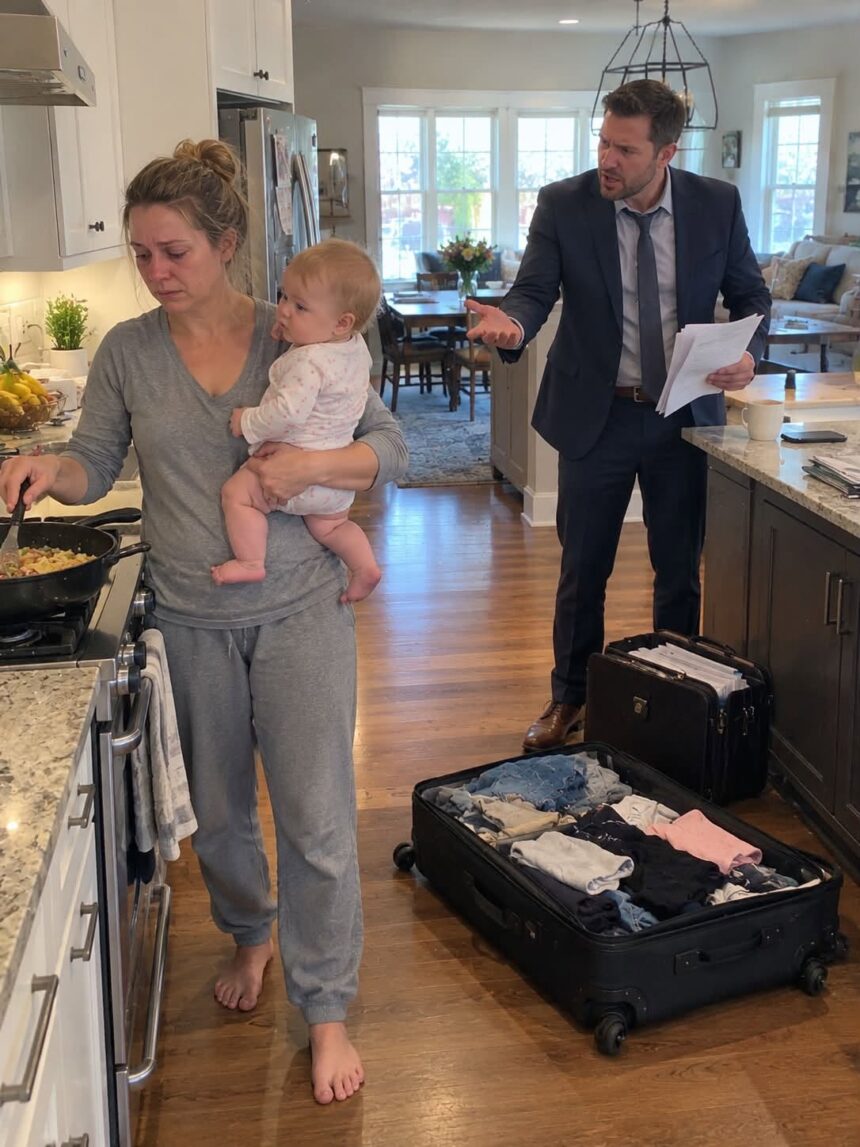
The suitcase that changed everything
At 4:52 AM, she had packed the essentials: clothes, diapers, feeding bottles, her laptop, passports, and the baby’s medical records.
Most importantly, she took the gray folder containing months of financial evidence.
When she carried the baby toward the car, Mark watched her with an amused expression.
“Where do you think you’re going?” he asked.
“Somewhere you can’t order me back,” she replied.
He laughed, convinced she was simply being emotional.
“You’ll come crawling back once you realize what you’re losing.”
She looked at him calmly.
“Mark, you’ll be calling me when you find out what you’ve signed.”
For the first time, his expression changed.
The documents that raised serious questions
Just after six in the morning, she arrived at the home of Evelyn Henderson, a retired attorney who had once mentored her professionally.
She placed the documents on Evelyn’s dining table and explained what had happened.
Evelyn listened carefully before beginning to examine the paperwork.
Within minutes, she discovered something concerning.
A bank account had reportedly been opened shortly before the baby’s birth. A transfer of $486,000 appeared in the records, and the account listed two names: Mark Mercer and his mother, Linda Mercer.
The money had allegedly been moved into a company called Meridian Hearth LLC, registered using Linda’s residential address.
Even more concerning, the company records suggested that funds had been used toward a deposit on a waterfront property.
But the financial documents weren’t the only problem.
Another paper appeared to show that the wife had voluntarily surrendered her rights to an investment account.
Her signature was printed at the bottom.
She immediately insisted that she had never signed it.
Evelyn examined the witness information and noticed another familiar name.
Mark’s sister.
The same person who had been sending breakfast instructions the previous evening was listed as a witness to the document.
What exactly had happened behind her back?
A phone call that exposed even more
Later that morning, Linda called repeatedly.
Eventually, the wife answered with Evelyn beside her.
“Come home immediately,” Linda demanded. “Mark has made his decision. Don’t make this more complicated than it needs to be.”
The woman calmly asked what she meant.
Linda responded that she had no job, no independent income, and no reason to challenge the financial arrangements.
She then instructed her to bring the baby home and sign whatever paperwork Mark provided.
But there was one major problem with Linda’s demands.
No formal divorce petition had even been filed.
Why was her mother-in-law already discussing financial rights and documents that supposedly needed to be signed?
Evelyn listened carefully.
When Linda finished speaking, the wife thanked her for confirming that she knew about the financial arrangements.
The silence on the other end of the phone was immediate.
Then Mark took over the conversation.
“What have you done?” he shouted.
“All I did was turn off the stove,” she answered.
The financial investigation takes a dramatic turn
With legal assistance, the woman began taking steps to preserve the financial records and protect her interests.
According to the account, emergency legal applications were prepared concerning the disputed accounts, the proposed property purchase, and the preservation of electronic evidence.
The financial investigation was becoming more complicated by the hour.
The waterfront property transaction was reportedly placed on hold while the relevant documents were reviewed.
Mark’s phone calls became increasingly desperate.
He repeatedly demanded that she reverse the actions.
But she had one question for him.
“Why was my money transferred into an account belonging to you and your mother?”
He had no convincing answer in that conversation.
Then Evelyn discovered another document connected to the property purchase.
It was an insurance application listing three intended occupants: Mark, Linda, and the couple’s newborn son.
The mother’s name was nowhere to be found.
She stared at the page, struggling to understand what it meant.
Had they planned a future without her while using money she believed belonged to her?
And why was their baby included in the paperwork?
The email that could change the entire case
Just when she thought the situation couldn’t become more disturbing, another document appeared.
Attached to the property application was an email allegedly written by Linda.
It outlined a proposed strategy for portraying the young mother as emotionally unstable after she left the family home.
The implication was deeply troubling.
If the documents were authentic, this was no longer simply a disagreement over money or a marriage ending in divorce.
It raised questions about whether the financial arrangements and the treatment of the mother were part of a much larger plan.
By late morning, the dispute had reached an emergency legal hearing.
Mark and Linda appeared together on a video screen, sitting in the same kitchen where the woman had prepared breakfast just hours earlier.
The food was still untouched.
The judge reviewed the submitted documents before lifting one particular email.
Linda’s expression changed as the judge began reading its opening sentence aloud.
For the first time that morning, she appeared unable to respond.
The woman sat quietly, holding her newborn close.
She had left the house with a suitcase, a baby, and a folder full of documents.
Now, the questions were no longer about whether she would beg her husband to stay.
They were about the money, the disputed signatures, the property transaction, and the alleged plan involving her child.
What exactly had Linda written in that email? And how would Mark and his mother explain the documents when the judge began asking questions?