Some betrayals are difficult to understand, especially when they come from the two people someone trusted most.
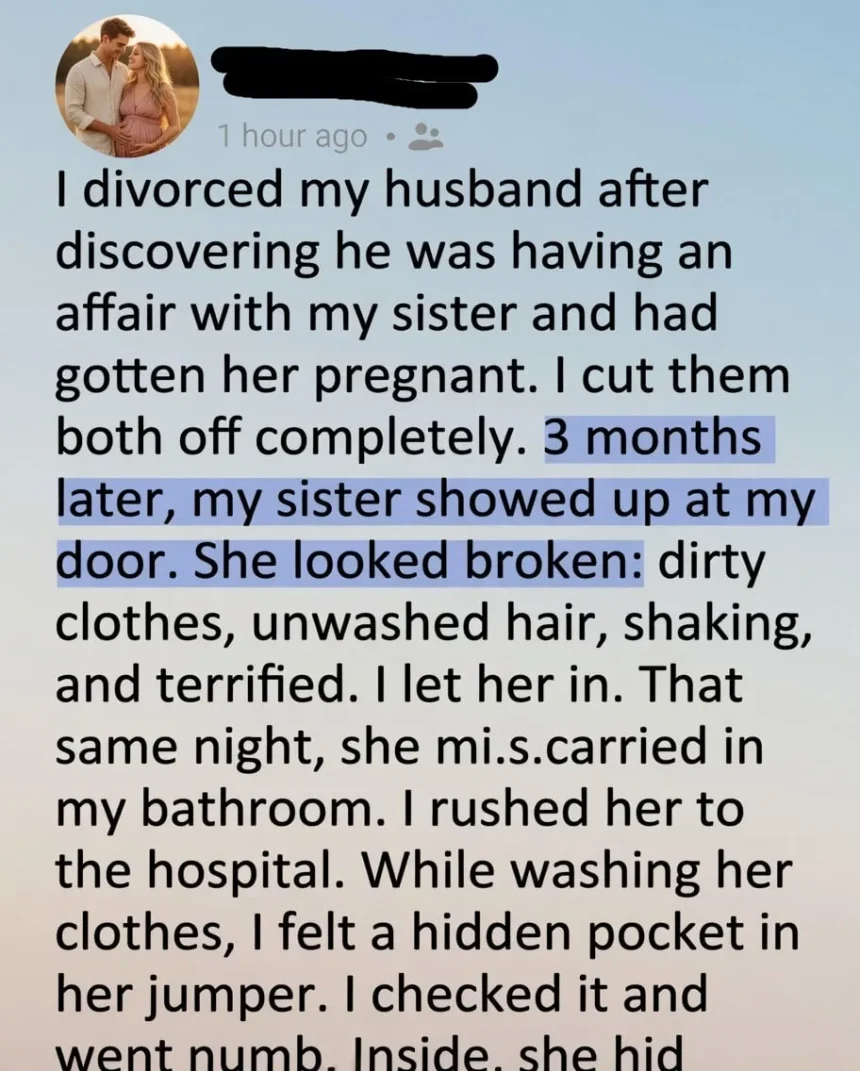
For one woman, the collapse of her marriage began with a discovery she never imagined making: her husband had been having a relationship with her own sister.
At first, she struggled to accept what was happening. Her marriage had lasted for years, and the two sisters had shared countless memories growing up. She had never imagined that the people closest to her could become the source of such deep pain.
But the situation became even more complicated when she learned that her sister was expecting a child.
The news left her devastated. She felt betrayed not only as a wife but also as a sister. Every shared family memory suddenly seemed different, and she found herself questioning how long the deception had been going on.
Rather than spend her days arguing or demanding explanations, she made a difficult decision. She began the process of ending her marriage and focused on creating a stable environment for her children.
For a while, distance seemed like the only way to protect herself.
She stopped communicating with her husband and kept her sister out of her life. It wasn’t because the memories had disappeared. It was because every conversation reminded her of what had happened.
Months passed, and she slowly began rebuilding her daily routine. She concentrated on her children, her responsibilities, and the small things that helped her feel in control again.
Then, one evening, someone knocked on her door.
When she opened it, she found her sister standing outside.
She looked exhausted and frightened. Her appearance was very different from the confident person the woman remembered. For a moment, neither of them knew what to say.
The woman had every reason to close the door. She had spent months trying to move forward without the person who had hurt her so deeply.
But something about her sister’s condition made her pause.
She allowed her inside.
Her sister didn’t arrive with excuses or accusations. She didn’t try to explain away the affair. Instead, she sat quietly, struggling to find the words to describe what had happened in her own life.
The relationship with the man had fallen apart. The promises she may once have believed were real had not resulted in the future she expected. She was now facing a difficult pregnancy and felt increasingly isolated.
Later that night, the situation took a frightening turn.
The sister began experiencing severe pain and bleeding. Realizing that something was seriously wrong, the woman immediately called for emergency medical assistance and accompanied her to the hospital.
Whatever anger remained between them, the immediate concern was her sister’s safety.
At the hospital, medical staff took over. After examinations and treatment, the family received devastating news: the pregnancy could not be saved.
The loss was heartbreaking.
While her sister rested, the woman returned home to collect a few personal belongings she needed for the hospital. As she went through the items, she noticed a small silver bracelet tucked inside a bag.
It was a delicate piece of jewelry, apparently prepared for the baby.
There was a name engraved on it—the same name as the woman’s.
She stood holding the bracelet for several moments.
She couldn’t know exactly what her sister had been thinking when she chose that name. Perhaps it was an attempt to honor the relationship they once shared. Perhaps it represented a hope that, despite everything, some connection between them might survive.
Whatever the reason, the discovery brought back memories of their childhood.
They had once been inseparable. They had shared secrets, celebrated important moments, and supported each other through difficult times.
Now, they were two people carrying different kinds of pain.
The woman returned to the hospital with the bracelet and sat beside her sister’s bed.
Her sister expected anger. She may even have expected to be told that she could no longer count on her family.
Instead, the woman reached for her hand.
There was no dramatic speech and no instant solution to everything that had happened. The betrayal had not suddenly become acceptable, and the pain did not disappear overnight.
But the woman recognized that she did not want the rest of her life to be defined by the actions of the man who had betrayed them both.
She also understood that forgiveness did not mean pretending nothing had happened.
It meant deciding what kind of relationship, if any, could exist in the future—and allowing time, honesty, and changed behavior to determine whether trust could ever be rebuilt.
When her sister was eventually discharged, the two began taking small steps toward repairing their relationship.
They spoke more honestly than they had in years. There were difficult conversations, moments of silence, and memories that were painful to revisit.
The woman continued to maintain boundaries, especially where her children and their emotional well-being were concerned. She did not rush into restoring the relationship or pretend that everything was normal.
But gradually, a new understanding began to develop.
The sisters had both experienced a painful loss. One had lost her marriage and the future she thought she had built. The other had lost her pregnancy and the relationship she had believed would provide her with a new beginning.
Neither could undo what had happened.
Over time, they began finding ways to support one another without ignoring the past. They learned that rebuilding a family relationship requires more than a single apology or an emotional moment. It requires accountability, patience, and consistent actions.
Their story is not a reminder that every betrayal should be forgiven or that every damaged relationship can be repaired.
It is a reminder that people sometimes face a choice between allowing pain to define every future decision and carefully deciding whether there is still something worth rebuilding.
For these two sisters, the road forward was difficult. But they eventually discovered that even after a family has been deeply hurt, healing may still be possible—one honest conversation at a time.