A LITTLE GIRL JUST WANTED TO FEEL THAT SHE STILL BELONGED
When my former husband announced that he was getting married again, our daughter was among the happiest people in the room.
She was nine years old and had spent years adjusting to life between two homes. Despite our separation, we had worked hard to make sure she never felt that she had to choose between her parents.
So when she heard about the wedding, she immediately started planning how she could make the day special.
She wanted to help choose flowers, prepare a little gift for the bride, and be part of the celebration.
For weeks, she talked about the wedding almost every day.
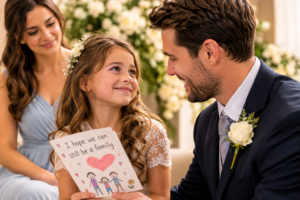
She even made a handmade scrapbook filled with family photographs and drawings. On the first page, she wrote that she hoped everyone would be happy together.
I thought it was beautiful.
But a few days before the ceremony, something happened that changed the way I looked at the entire situation.
My daughter came home unusually quiet.
When I asked about her day, she hesitated before telling me that the wedding arrangements had changed.
Apparently, she had been told that some parts of the celebration would be reserved for the couple’s new beginning, and that she shouldn’t expect to be included in everything.
At first, I didn’t think much of it. Weddings involve complicated arrangements, and children don’t always understand every decision adults make.
But then she asked me a question I wasn’t prepared for.
“Mom, when Dad gets married, will I still be part of his family?”
I put down what I was holding and sat beside her.
“Of course you will. Nothing about a wedding can change that.”
She nodded, but I could see that my answer hadn’t completely reassured her.
The following weekend, I spoke with her father.
I explained that our daughter had started feeling uncertain about her place in his life.
He seemed genuinely surprised.
He told me he had no idea she was feeling excluded and promised to speak with her.
I hoped that would resolve everything.
Then, on the morning of the wedding, my daughter received a message asking her to arrive later than the other family members.
She had originally been told she would help with the family photographs.
Now she wasn’t sure whether she was even expected to be there.
She sat on the edge of her bed, holding the scrapbook she had spent so many evenings preparing.
“Maybe they don’t need me anymore,” she whispered.
Those words broke my heart.
I decided we weren’t going to rush into anything. I told her she didn’t have to attend an event where she felt uncomfortable, and that her feelings mattered just as much as anyone else’s.
But she still wanted to see her father.
When we arrived, he came outside to greet us.
The moment he saw the scrapbook in her hands, he smiled and asked to see it.
She handed it to him.
He slowly turned through the pages, looking at the photographs and little messages she had written.
Then he reached the final page.
It contained a simple sentence:
“I hope we can still be a family, even when things change.”
He stopped turning the pages.
For a moment, nobody spoke.
Then he knelt in front of his daughter and asked her why she had written that.
She looked down.
“Because I don’t want to lose my place in your life.”
His expression changed immediately.
He hugged her and told her that she would never have to compete with anyone for his love.
He then went inside and asked for a private conversation with his future wife.
The wedding preparations were briefly put on hold while the adults discussed what had happened.
For the first time, everyone had to acknowledge something that had been overlooked: starting a new marriage doesn’t mean leaving an existing child behind.
The celebration eventually continued, but some arrangements were changed.
The little girl was included in the family photographs, and her father made sure she knew she had an important place in his life.
Later that evening, she sat beside him, holding his hand.
She didn’t need an expensive gift or a special title.
She had wanted something much simpler.
To know that she still belonged.
And perhaps that is one of the most important lessons in blended families: children should never have to earn their place in the lives of the adults who love them.
Because relationships may change, households may grow, and new chapters may begin.
But a child’s need to feel loved and accepted should never become an afterthought.